
Charlie's Art
 |
Charles M. Russell
|
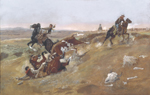
Although Russell was not much of a cowpuncher himself, he admired his friends who were top hands and watched them as they went about their daily business. Many of Russell’s paintings isolated the cowboy and horse in an elemental contest. He enjoyed creating complicated, story-telling pictures that allowed the action to unfold before the viewer. |
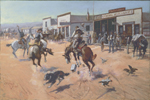 |
Charles M. Russell Utica ( A Quiet day in Utica) 1907 Oil on canvas 24 1/8 inches x 36 1/8 inches |
This action painting of Utica’s main street was commissioned in 1907 by Charles Lehman’s sons. Although the Lehman store in Utica had already closed, the painting was used to advertise the Lehmans’ Lewistown store. In the painting, Charlie Russell, himself, leans against the hitching post while Charles Lehman lounges in the doorway. |
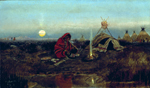 |
Charles M. Russell Grubpile (The Evening Pipe) 1890 Oil on canvas 9 5/8 inches x 16 3/8 inches |
In Grubpile, the solitary Cree seems oblivious to the activity around him as he finds solace with each puff on his pipe. Indians made smoking into a ritual and, in some cultures, a part of religious practice. In this painting the blanket-wrapped figure is seated beside his small fire and his temporary shelter. While Russell was known for his ability to paint action, in many cases his Indian pictures revealed a more contemplative side. |
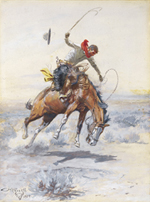 |
Charles M. Russell The Bucker 1904 Watercolor, pencil & gouache on paper 16 1/4 inches x 12 1/4 inches |
Russell had a knack for capturing a horse in motion. He could twist a man or animal anyway he chose for the purpose of action. The vertical composition of this painting heightens its visual impact, emphasizing the towering height of the horse and rider as they crowd the edges of the painting. |